Asphalt repair in Little Rock that fixes the cause, not just the hole
Potholes and failed sections cut out and rebuilt in Little Rock and every town in Arkansas. We look for what gave way under the asphalt (water, soft ground, or too much weight) and fix that too.
Call (501) 506-6799Available 24/7. Press 1 and you'll reach a person.
- Licensed and insured
- Family-owned
- 11 years in business
- Free written estimates
- Edges saw-cut straight down, past the old damage (dashed) into sound pavement.
- Failed asphalt, wet base, and soft ground dug out.
- New stone base, placed and compacted a layer at a time.
- Tack coat on the cut faces of the old asphalt.
- Hot mix placed and rolled level with the pavement around it.
Most potholes start as water in a crack
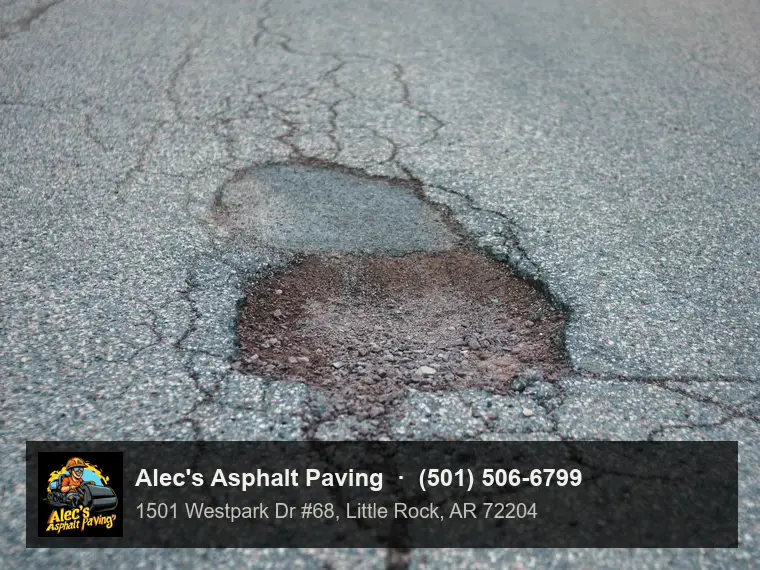
A pothole looks like a problem with the asphalt surface, but it starts underneath. Water runs down a crack, soaks the stone base, and softens it. Every vehicle that rolls over that soft spot bends the asphalt a little, until it breaks into chunks and the chunks work loose.
Winter speeds it up. In Little Rock, Arkansas, freezing nights run from about the second week of November into late March, and water that freezes in a crack pries it wider every time.
So a patch that only fills the hole is sitting on the same wet, soft base that made it. Is it any wonder the pothole comes back? A long-lasting repair answers two questions before anything gets cut: what failed, and why.
What the damage is telling you
- Pothole
- Water has been reaching the base for a while, and the asphalt pavement around the hole is often weaker than it looks.
- Alligator cracking
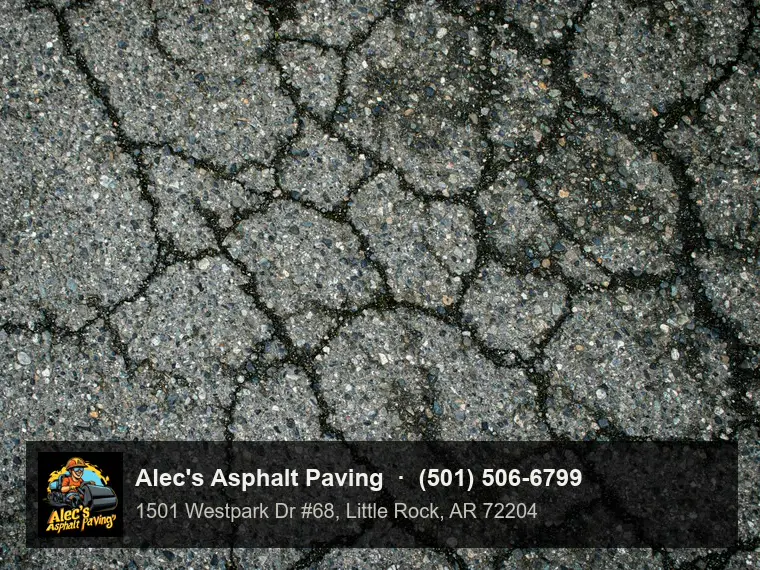
- Cracks joined into small pieces. The base under them has stopped carrying the load, so that whole section gets cut out, not filled.
- Block cracking
- Big rectangles across the surface. The asphalt has dried out with age, which is a surface problem. Crack sealing and sealcoating usually handle it with no digging.
- Sunken spot
- A dip that holds water. The ground under it has settled, and the puddle keeps soaking it, so it deepens with every storm.
- Crumbling edge
- The side of the pavement has nothing holding it up. The fix rebuilds the edge and firms up the ground beside it, or it breaks off again.
Can't tell which one you've got? Call and tell us what you're seeing. (501) 506-6799
How a failed section of pavement gets cut out and rebuilt
The five steps below match the numbered notes on the drawing at the top of the page. Together they make a full-depth repair, the one a failed base needs.
Cut the edges straight down
The repair area is marked out square, past the last crack, into pavement that's still sound. A saw cuts the edges straight down, so the new asphalt butts against clean, solid faces instead of a ragged, crumbling rim.
Dig out everything that failed
The broken asphalt comes out first, then the wet or soft base under it, and any soft ground below that. Stone that's been sitting in water and mud won't pack firm again, so it gets replaced, not reused.
Rebuild the base in layers
Crushed stone goes back in one layer at a time, and each layer is compacted before the next goes on. Stone dumped in all at once and packed only on top settles later, and it takes the patch down with it.
Tack the cut faces
The cut edges of the old pavement get a coat of liquid asphalt, called tack, so the new mix bonds to them. Without it, the seam around the patch is where water finds its way back in.
Fill with hot mix and roll it level
Hot mix asphalt goes in and gets compacted with a roller, or a plate compactor in a tight corner, until it's firm and flush with the pavement around it. Left high, a patch takes a hit from every tire. Left low, it's a puddle.
Want to know how deep your repair has to go? (501) 506-6799
An asphalt repair goes as deep as the damage does
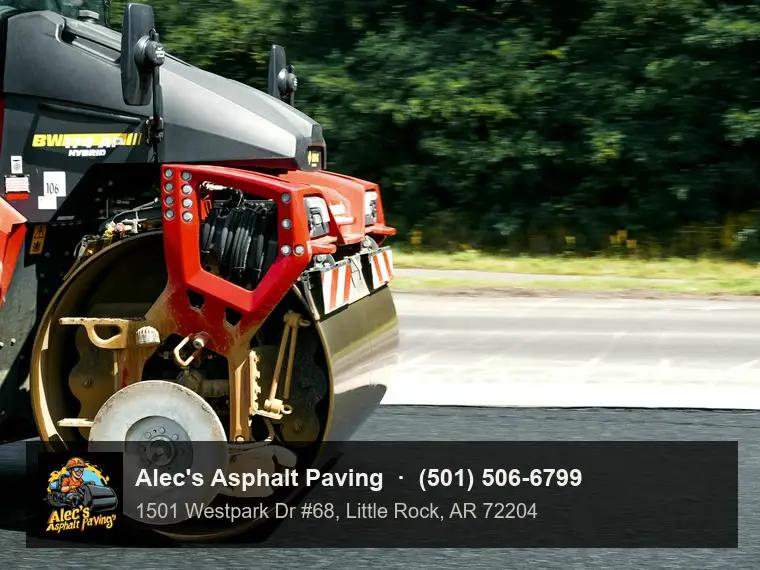
Not every repair means digging to dirt. When the damage stays in the asphalt, like a shallow break or raveling (the surface wearing away until loose stone shows), the bad asphalt is milled or cut out down to sound material and replaced. The base stays put. That's a partial-depth repair, and it costs less.
When the base has failed, a partial-depth patch is a new lid on a soft box. It can look fine for a season, then it sinks or cracks along its own outline. There, only a full-depth repair fixes the problem.
Ask any contractor which depth they're pricing for each spot, and get the answer on paper.
When patching stops making sense
Patches are the right fix when the damage is in spots. When more of the surface is failing than holding, when new patches keep going in beside old ones, or when the same driveway needs work every spring, you're paying to repair pavement that's worn out.
Damage that widespread usually means the base is going too, and then new asphalt paving, a new driveway, or parking lot paving is the better spend, even though it's the bigger job. You'll hear that from us before you pay for another patch.
Is yours past patching? (501) 506-6799
Arkansas prices for patching and pothole repair
General market ranges for Arkansas, not a quote. Bigger repairs are priced by the square foot; a single pothole is usually a small job of its own.
| Work | General range |
|---|---|
| Patching and failed-section repair | $3–$15 per sq ft |
| A single pothole, most jobs | $150–$600 |
The final price depends on the job: how many spots there are, how deep each one has to go, how easy they are to reach, and what the ground under them needs. Your written estimate is free. (501) 506-6799
Why the range runs so wide
Depth, mostly. A partial-depth patch on a sound base sits toward the low end. A full-depth repair that digs out soft ground and rebuilds the base sits toward the high end, and so do small spots that are hard to get equipment to.
Water can add a line, too. If a low spot keeps collecting rain, the fix may include reshaping the pavement or the ground around it so the water goes somewhere else. It costs more today. It costs less than doing the same patch twice.
What customers say about the work
-
★★★★★
Two potholes at the end of our driveway kept getting worse every time it rained. I called Monday, got a quote Tuesday, and it was fixed by Thursday. It's a small job but they treated it like it mattered. Will call them again.
Denise R.
-
★★★★★
A utility crew dug up part of our driveway to fix a water line and left a rough patch. Alec's crew cut it back clean and repaved it so you honestly can't tell anything happened. Great work and easy to deal with.
Brian K.
-
★★★★★
Alec's company handled pothole repairs and resurfacing for our subdivision's private roads. The crew was very professional with handling local traffic flow and keeping the residents happy while the work was being done.
Thomas B.
A driveway and a parking lot break for different reasons
A repair works the same way on residential and commercial pavement, from a home driveway to a church lot or a private road. What changes from one to the next is where the pavement gives out, and what the repair has to carry afterward.
Driveways
On a home driveway, trouble usually starts at the apron where the drive meets the street, along edges with nothing but lawn beside them, and anywhere a downspout or a slope sends water across the surface. A moving truck or a loaded trailer parked in one place can press in a sag that holds rain. Fixing those spots, and the water behind them, keeps the rest of the driveway from following.
Parking lots
Parking lots break where the weight turns and stops: entrances, drive lanes, the dumpster pad, the loading zone. A patch there has to be built for the garbage truck, not for the car parked beside it. On any lot, a broken edge by the front door is also a trip hazard, which is a good reason to fix it first. A certificate of insurance is available on request.
Private roads and farm lanes
Long private roads tend to fail at low spots and washouts, where water crosses the road surface or sits beside it. Repairs out there usually include the ditch or the shoulder, not just the asphalt.
Paving services that often follow a repair
Crack Sealing and Filling
Seals the cracks around a repaired spot so water can't start the next one.
Sealcoating
A protective coat over the whole surface, after the repairs, against sun and water.
Overlay and Resurfacing
A new layer over pavement that's sound underneath but worn on top.
Asphalt Maintenance
Parking lot maintenance on a cycle: crack sealing, patching, sealcoating, and restriping.
Line Striping
Puts stall lines, arrows, and accessible spaces back where a repair cut through them.
Managing a lot with more than a few bad spots? (501) 506-6799
Serving Little Rock and every other town in the state
Alec's Asphalt Paving works from a yard in Little Rock, AR. We repair pavement in every town in Arkansas.
- Hot Springs
- Lonoke
- Malvern
- Mayflower
- North Little Rock
- Pine Bluff
- Sheridan
Call from anywhere in the state. (501) 506-6799
Questions about pothole and asphalt driveway repair
How much does it cost to repair a pothole?
Most single potholes fall inside the range in the price table above. Your own number comes on a free written estimate.
Can I fix a pothole in my driveway myself?
You can fill one to buy time, but a bag of cold patch won't fix it. Store-bought cold patch stays soft, doesn't bond well to the old asphalt, and gets pushed out by tires, especially over a wet base.
Can you patch a hole in asphalt with concrete?
You can, but it rarely lasts. Cement concrete is rigid and asphalt concrete flexes, so the two move differently under traffic and in summer heat, and the seam between them opens up. Water finds that seam fast. A hole in asphalt should be patched with asphalt.
Can you put new asphalt over old cracked asphalt?
Over cracks in sound pavement, often yes. Over failed spots, no. A new layer copies what's underneath it, so potholes and patches of alligator cracking get cut out and repaired before an overlay goes on.
What is the cheapest way to repair an asphalt driveway?
Fix it while it's small. A crack sealed this year costs a fraction of the pothole it can turn into. Waiting is the expensive option.
Will the patch match the rest of my driveway?
Not at first. New hot mix is a deep black, and asphalt that's been out in the sun for a few years has faded to gray, so a fresh patch stands out. The difference softens as it weathers. Sealcoating the whole driveway evens it out sooner, once the patch has had time to cure.
Can I fix a pothole in the road in front of my house?
Usually not, if it's a public street. The road belongs to whoever maintains it, most often the city, the county, or the state, so report the pothole to them. We work for whoever owns the pavement: homeowners, businesses, churches, and municipalities.
Call before the pothole spreads.
Tell us where the damage is, roughly how big, and whether water sits there after rain. We'll set up your free written estimate from there.
Call (501) 506-6799Available 24/7. Press 1 and you'll reach a person.
Ask about the warranty on your job when you call. It depends on the work.