Parking lot paving in Little Rock, built for trucks and heavy rain
New asphalt lots, full replacements, and mill and overlay for businesses, churches, property managers, and cities in Little Rock and every town in Arkansas. The drainage and the truck traffic are planned before any hot mix arrives.
Call (501) 506-6799Available 24/7. Press 1 and you'll reach a person.
- Licensed and insured
- Family-owned
- 11 years in business
- Free written estimates
- Storm inlet at the lot's low point, where every slope runs. A pipe (dashed) takes the water to the storm sewer.
- The entrance apron, where every car and truck turns in from the street.
- The drive aisle, sized for the biggest vehicle that serves the building.
- Stall rows, fitted around the aisle and the entrance.
- The accessible stall and its striped access aisle, nearest the door, with a curb ramp to the sidewalk.
Resurface the lot, or tear it out and start over?
A tired parking lot doesn't always need new asphalt from the ground up. The question is whether the damage stops at the surface or goes all the way down, and you can usually tell by walking it.
Surface wear looks like this: the lot has gone gray and rough, loose stone is working up, and long cracks run through pavement that's still flat and firm. That lot is a candidate for a mill and overlay, or, if it's younger, crack filling and a sealcoat.
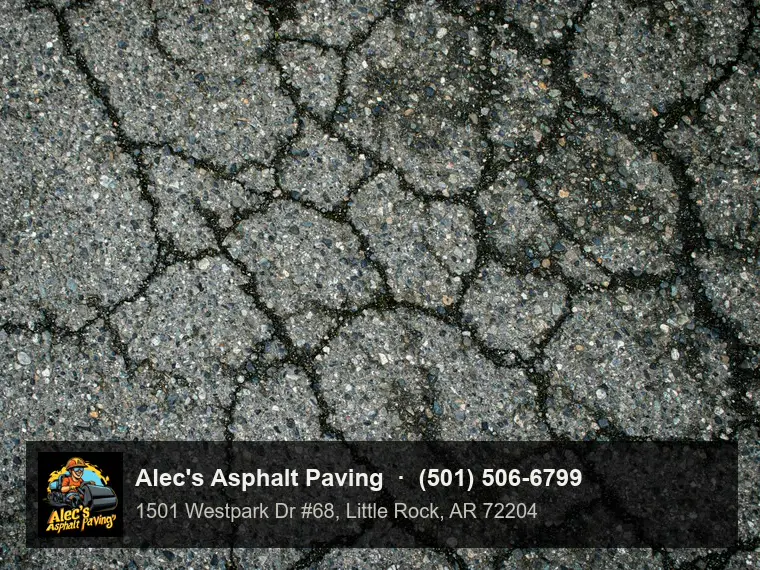
Failure looks different. Cracks join up into small, many-sided pieces, potholes reopen after every patch, the drive lanes sink where trucks turn, and water sits in a parking row for a day after it rains. Those are base problems. Pave over them and the old cracks work up through the new layer, so the failed areas get cut out, or the whole lot rebuilt.
Most lots land in between, sound across most of the surface with a few failed spots by the entrance or the dumpster. Those spots get full-depth asphalt repair, then an overlay goes across the whole lot, usually for far less than a rebuild.
Why a parking lot overlay gets milled first
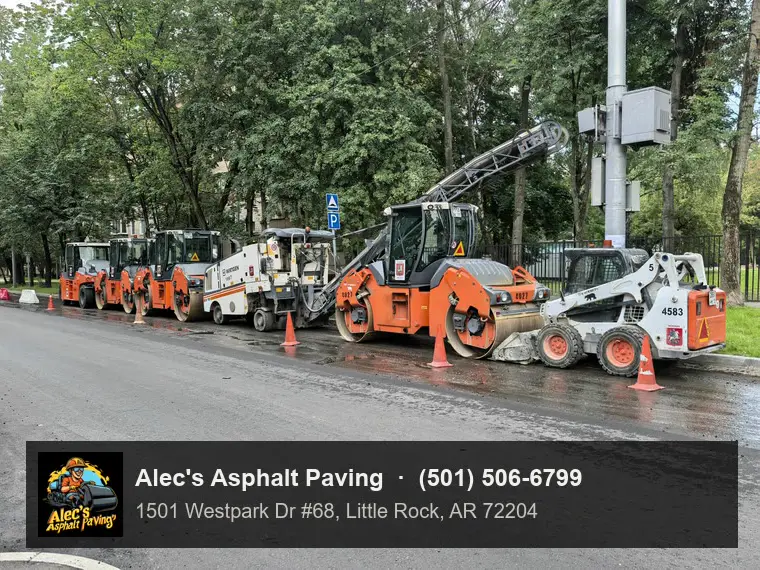
Milling grinds the top off the old surface so the new one finishes flush with the curbs, the gutters, the storm inlets, and the doorways. Skip it and the whole lot comes up: water dams against the curb instead of reaching the gutter, and every door gets a lip to catch a toe. A tack coat then bonds the new overlay to the old asphalt.
Describe the cracks and the wet spots when you call. (501) 506-6799
A parking lot is laid out around its water and its traffic
The five steps below match the numbers on the plan at the top of the page. They're settled in this order, because each one depends on the one before it.
Find the low point and send the water to it
Every square foot of a lot has to slope toward somewhere water can leave: a storm inlet, a curb opening, or the street. Grade it too flat and rain sits in the parking rows, soaks in through the cracks, and softens the stone base until potholes open. So the grades come first.
Plan the entrance for the turn
The apron where drivers turn in takes more wear than most of the lot, because every tire twists and brakes there. It has to meet the street without a bump or a lip, and without sending the lot's water across the sidewalk.
Size the drive aisle for the biggest vehicle
Who actually drives through? Customers, sure. Also the garbage truck, the delivery van, and sometimes a fire engine. The aisle has to be wide enough for them to swing through and built to carry them.
Fit the stall rows
The stalls go in around the aisle and the entrance, sized and angled for how people park there. Get it right on the new surface and line striping later is just repainting the same lines.
Put the accessible stall closest to the door
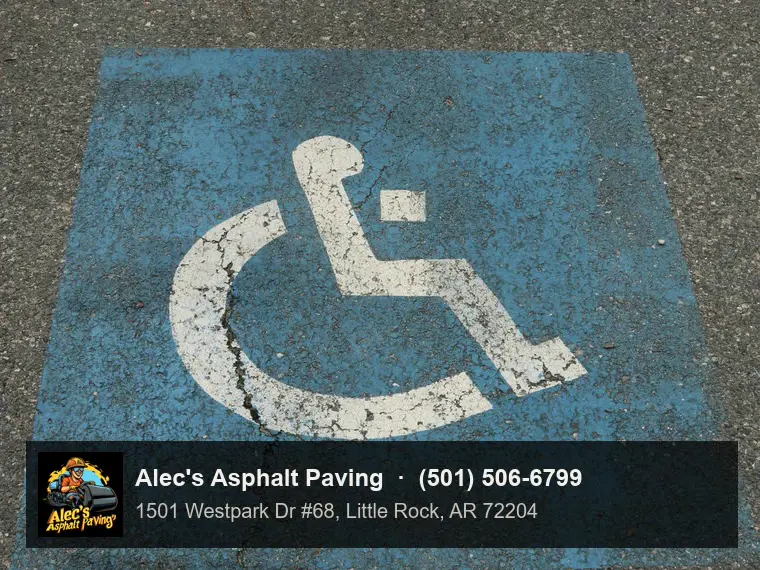
Accessible stalls and their striped access aisles go on the shortest route to an accessible entrance, with a step-free way from the aisle to the door, usually a curb ramp up to the sidewalk. The ground under them has to be close to flat, so a wheelchair doesn't roll while someone gets in or out. That's settled when the lot is graded, long before anyone paints a symbol.
Then the lot is built like any new asphalt pavement: soft ground dug out, a stone base compacted, hot mix asphalt laid and rolled, and the striping last. The asphalt paving page covers that part step by step.
Water standing in the same corner after every storm? (501) 506-6799
Where the trucks drive, the lot has to be built heavier
Cars are easy on a parking lot. Trucks do the damage. One loaded garbage truck puts more wear on pavement than a long line of cars, because the damage climbs steeply with the weight on each axle.
That's why a well-designed commercial asphalt lot usually isn't one thickness from corner to corner. The stall rows, where cars park and sit, can take a lighter section. The entrance, the truck route, the loading area, and the approach to the dumpster get a heavier one, with more asphalt and a deeper base.
Two lots can look the same the day they're finished. The one built heavier where the trucks run is the one still flat in its drive lanes years later. So get it on paper: ask whether a bid treats the lot as one section or two, and get the thickness for each. Our quote states it in inches, compacted.
What to line up when you're comparing bids
- Square footage. Measured the same way on every bid, or the price per foot tells you nothing.
- Thickness by area. Stalls and truck lanes, each in inches, compacted.
- The base. How deep it goes, and how failed spots get handled.
- Drainage. Where the low points are, and which inlets get added or rebuilt.
- Phasing. Which sections close, in what order, and for how long.
- Changes. Anything outside the bid gets agreed in writing before it's done.
Hold our bid to the same list. (501) 506-6799
Parking lot prices in Arkansas, new or resurfaced
Here's what commercial parking lot paving generally costs in Arkansas: a market range, not a quote, for a rough budget before the bids come in.
| Work | General range |
|---|---|
| Parking lot, new or full replacement | $3–$10 per sq ft |
| Parking lot mill and overlay | $2–$6 per sq ft |
The final price depends on the job: the size of the lot, how much of the base has failed, what gets milled and hauled away, and how easy it is to work around your traffic. The estimate is free, and it's in writing. (501) 506-6799
What customers say about the work
-
★★★★★
I wasn't sure a Little Rock company would drive up to Northwest Arkansas for our small lot, but Alec's crew did and treated it like a local job. On time, tidy, and a good price.
Karen O.
-
★★★★★
Our industrial facility lot takes a heavy beating from delivery trucks. Alec's Asphalt came in over the weekend to resurface the worst sections and restripe everything so it wouldn't disrupt our normal business hours. Top-notch service.
Robert M.
-
★★★★★
I look after the property for our church. The lot had cracks everywhere and the lines were faded. They resurfaced the whole thing and restriped the spaces and handicap spots over about a week, working around our Wednesday night and Sunday services so nobody lost parking. I always knew what was happening next. Great value for a church budget.
Kyle B.
Parking lots for businesses, churches, landlords, and cities
A parking lot is the first part of a property a visitor touches, and the place people trip, blow a tire in a pothole, or slip where water froze overnight. What changes from one property to the next is who has to keep using the lot while the work happens.
Stores, restaurants, and offices
Customers still need a way in, so commercial lots are usually paved in sections with one entrance open. Tell us your busiest days when you call, and the sections get planned around them.
Churches
A church parking area fills for a few hours a week and sits mostly empty the rest. That makes it one of the easier lots to pave without shutting anything down.
Apartments and property managers
Tenants need notice and somewhere to park. Get the phasing in writing so you can pass it along, with a quote clear enough to take to an owner or a board.
Cities, counties, and schools
Public lots usually come with a written specification and a bid form, and the price should follow the spec line for line.
General contractors
On new construction, the lot follows the site's civil drawings, down to the grades and inlet elevations on those sheets.
A certificate of insurance is available on request.
Parking lot maintenance after it's paved
Asphalt Repair
Potholes and failed patches cut out and rebuilt full depth.
Crack Sealing and Filling
Cracks sealed before rain can reach the base under the drive lanes.
Sealcoating
A coat that slows sun and water damage on a lot that's still sound.
Line Striping
Stall lines, accessible stalls, arrows, and fire lanes, painted to the lot's layout.
Asphalt Maintenance
The upkeep cycle for a commercial lot, done in the right order.
Based in Little Rock, paving lots across Arkansas
Alec's Asphalt Paving runs out of a yard in Little Rock. Here are a few of the towns we cover:
We pave lots in every town in the state. See all 109 towns
Tell us where the lot is and roughly how big. (501) 506-6799
Questions about parking lot paving
How much does it cost to pave a parking lot?
See the price table above for general Arkansas ranges. Your own number depends on what's under the surface, so it comes on a free written estimate.
How thick should parking lot asphalt be?
There's no single right number. It's worked out for each lot from its traffic, its ground, and its drainage, so be wary of any asphalt contractor who gives you one over the phone before walking the lot.
How long does it take to pave a parking lot?
It depends on the size and the base work, and most of the time goes into what happens before the paving. Tearing out old asphalt, fixing soft ground, and waiting on the weather all take longer than laying the hot mix.
Do you need a permit to pave a parking lot?
Often, for a new lot, a new entrance onto a public street, or a change to where the water drains. Rules differ from one city or county to the next, so check with the local permit office before a start date is set.
Is asphalt or concrete better for a parking lot?
For most parking lots, asphalt. Asphalt generally costs less up front, opens to traffic sooner, and is quicker to patch. Concrete earns its place in small spots that take a pounding, like a dumpster pad.
When is the best time of year to pave a parking lot in Arkansas?
Spring through fall, on warm, dry days. Hot mix needs its heat to compact, and cold air steals it. Around Little Rock the normal freeze window runs from about November 10 to March 21 (NOAA 1991–2020 normals), so winter is the time to collect bids.
How long does a parking lot last?
Thickness, base, and drainage decide it: they're the difference between fifteen years and three. Upkeep adds years on top, especially where Arkansas heat dries out the surface and summer storms find every open crack.
Tell us about the lot.
Its rough size, what's cracking, where water sits after a storm, and what drives through it. That's plenty to get a free estimate set up.
Call (501) 506-6799Available 24/7. Press 1 and you'll reach a person.
Ask about the warranty on your job when you call. It depends on the work.