Asphalt crack sealing in Little Rock, while it's still just a crack
Cracks sealed in driveways, parking lots, and private roads in Little Rock and every town in Arkansas. You'll hear which cracks sealing will stop and which ones point to a base that needs repair.
Call (501) 506-6799Available 24/7. Press 1 and you'll reach a person.
- Licensed and insured
- Family-owned
- 11 years in business
- Free written estimates
- Rain runs across the surface and into the open crack.
- The water soaks into the stone base below.
- The surface sags over the wet base, and the crack's edges break away.
- Sealant fills the cleaned, dry crack and holds onto both walls.
- A band over the top covers the edges and sheds the rain.
- The base under the sealed crack stays dry.
The crack isn't what ruins asphalt. The water is.
Asphalt cracks for ordinary reasons. It dries out and shrinks as the sun ages it, it expands and contracts between summer and winter, and it flexes a little under every tire. A crack by itself does little harm. It's an opening, though.
Rain runs across the pavement until it finds that opening, then goes straight down. Right under the asphalt sits the stone base, compacted and meant to stay dry. Soaked stone and wet ground lose their grip. The surface over them starts to sag and flex, and every vehicle that rolls across knocks a little more off the crack's edges.
Arkansas weather gives that water plenty to work with: rain that adds up to about 50 inches a year around Little Rock, and winters cold enough to freeze it. Water that freezes in a crack swells and pries it wider. So the crack you shrugged at in October can be a pothole by April.
Crack sealing closes the opening, so rain runs past the crack instead of into it. It's cost-effective for a plain reason: it's usually the smallest bill in asphalt work, and it keeps the big ones (patching, pothole repair, a whole new surface) further down the road.
Cracks showing up in your driveway or parking lot? Tell us what you're seeing. (501) 506-6799
Which cracks sealing fixes, and which it can't
Sealant works on asphalt that's still solid underneath. You can usually tell from the pattern the cracks make and what their edges are doing.
- Single crack
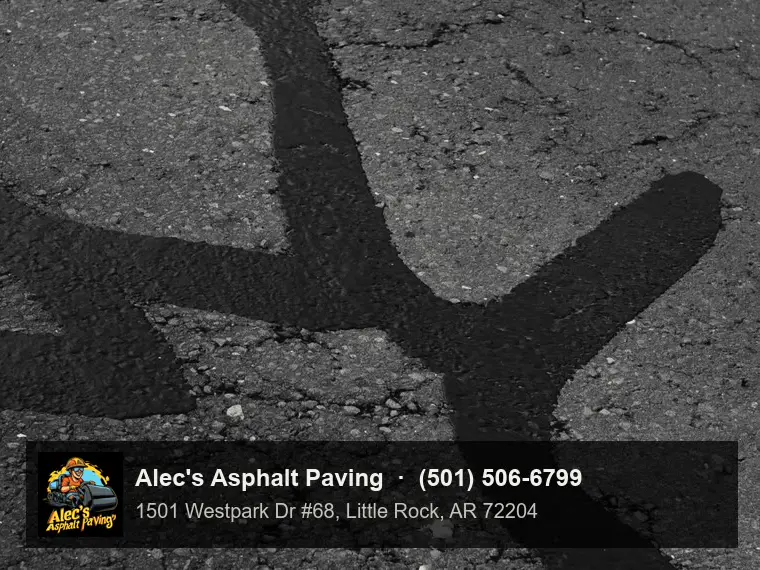
- One crack running along or across the driveway or lot, edges still tight. Seal it.
- Seam
- Where the asphalt meets a garage slab, a curb, a concrete gutter, or an older patch. Seal it.
- Block cracks
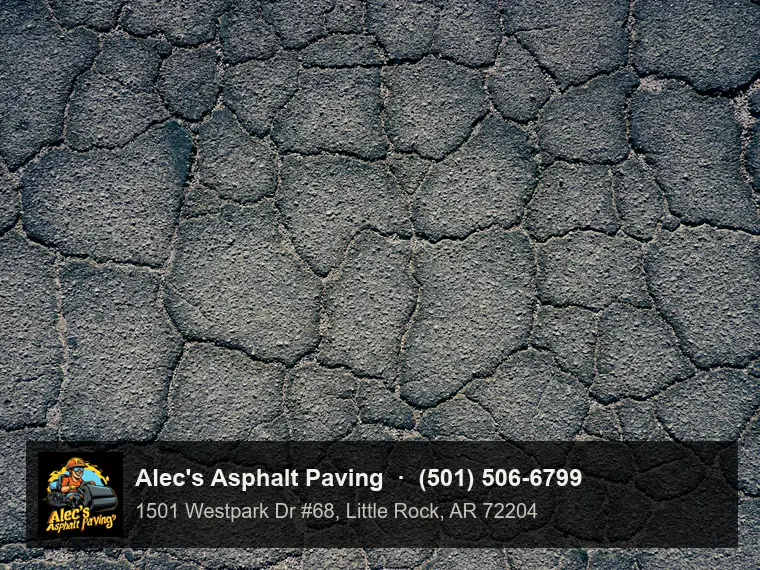
- Cracks that split older, dried-out asphalt into big, rough squares. Seal the cracks, then sealcoat the whole surface.
- Hairline cracks
- Too fine to take sealant. A sealcoat covers them once the wider cracks are sealed.
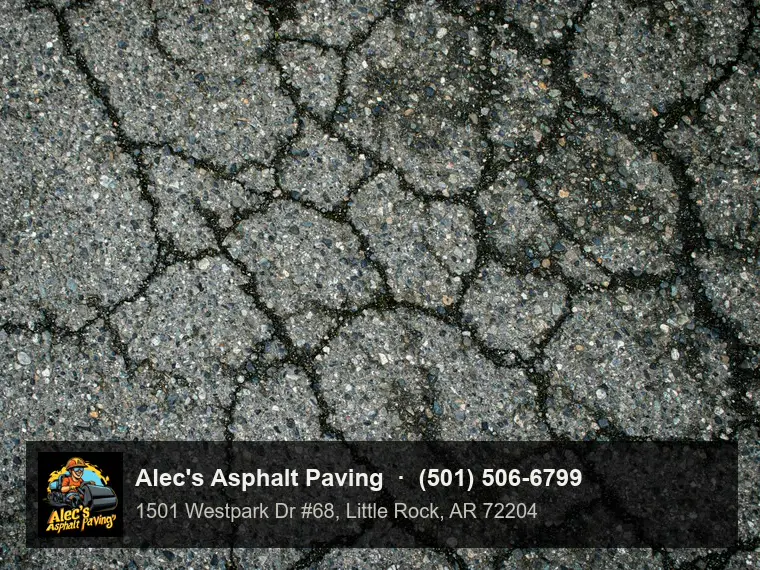
- Alligator cracks
- Small connected pieces, often in a wheel path. That section gets cut out and repaired.
- Sunken edges
- A crack sitting in a dip, or with chunks coming loose, points below the surface. That's usually a repair.
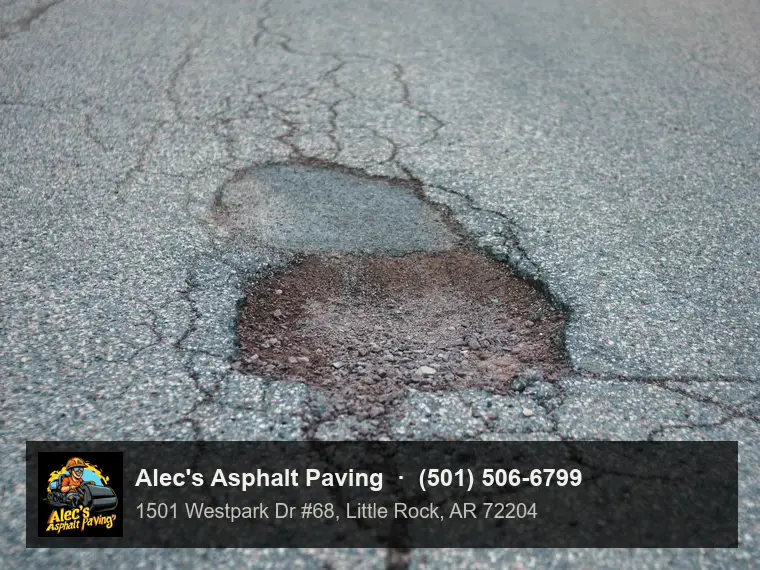
- Pothole
- A hole needs a patch. Sealant can't replace what's already gone.
Not sure which of these you've got? That's what the call is for. (501) 506-6799
When it's more than a crack
Asphalt Repair
Alligator cracking, sunken cracks, and potholes, cut out and rebuilt.
Overlay and Resurfacing
A new layer over a sound base with too many cracks to seal one by one.
Residential Driveways
A new driveway when the old one is past saving.
Parking Lots
Repair and full replacement for lots where the base has failed.
How the cracks get sealed
Notes 4 and 5 on the drawing at the top show a finished crack. Most of what makes one last happens before any sealant comes out, and you can't see it afterward, so it's worth asking about.
Every crack gets a look first
Walking the surface sorts the cracks into the ones worth sealing and the ones pointing at trouble underneath. Anything that needs repair instead should be its own line on the estimate, with the reason beside it, so you're never paying to seal over a failure.
Cleaned out to bare walls
Dirt, loose stone, grass, and old sealant that's let go all come out, with a stiff brush and compressed air or by cutting the crack to a clean edge. Sealant only holds onto clean walls. Poured over dust, it peels away the first time the crack opens.
Dry, or it waits
Water left in a crack keeps sealant from bonding, so the work waits for dry pavement. Annoying after a heavy rain. It's also the difference between a seal and a stain.
Filled, then banded over the top
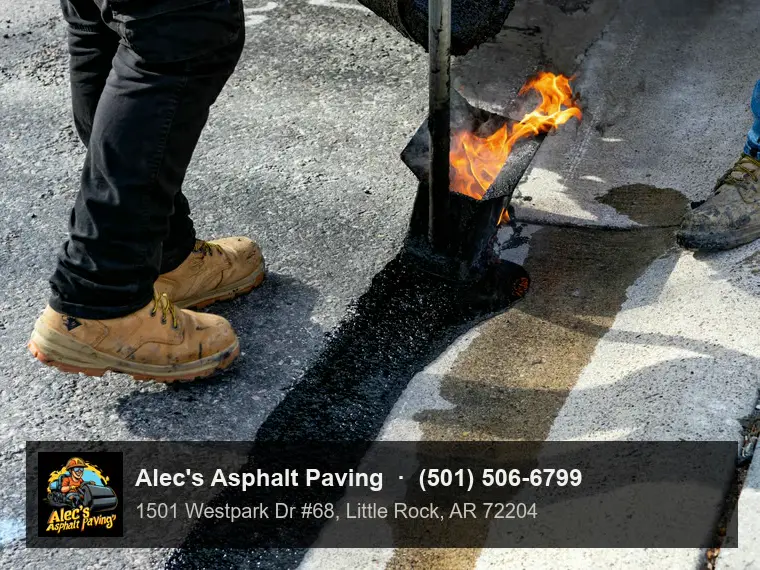
The crack is filled from the bottom up, so no air pocket gets trapped under the surface. The last of the sealant is spread in a band a little wider than the crack, covering its broken top edges and shedding water off to the sides.
Changes agreed before they happen
Sometimes a crack turns out worse once it's cleaned out: a soft spot beneath it, or edges that crumble. Any change to the job, and to the price, should be agreed with you before the work goes further.
Want to know what's under a crack before you pay to seal it? (501) 506-6799
Seal the cracks first, then sealcoat
Sealcoating is a thin protective coat. It shields a sound surface from sun and water, and it isn't made to fill a crack. Spread over an open one, it dips into the top or bridges across it, and the first time the pavement moves, the crack is back.
So the cracks get sealed first and have time to set, then the sealcoating goes on over everything. On a lot, line striping comes last, on the fresh coat.
On a commercial parking lot, that same order, with patching added wherever something has failed, is what an asphalt maintenance program is made of.
Pricing crack sealing and sealcoating together? We'll quote both. (501) 506-6799
What crack sealing costs in Arkansas
Crack sealing is priced by the length of the cracks, not the size of the surface. Across Arkansas, the general range looks like this, and it isn't a quote.
| Work | General range |
|---|---|
| Crack filling | $1–$5 per linear ft |
The final price depends on the job: its size, access, the condition of what's there, and how much prep the cracks need. Your written estimate is free. (501) 506-6799
What makes one crack job cost more than another
- Total length. A lot with a few long cracks can cost less than a small driveway that's cracked all over.
- Width, and what's in them. Wide cracks take more sealant, and cracks packed with dirt or grass take longer to clean out.
- Seams. Runs along curbs, gutters, and slabs add feet quickly.
- Repairs first. A section that has to be patched before the cracks around it can be sealed is priced on its own.
- Distance and access. The drive from Little Rock, and how easily the crew can reach the cracks.
Want a rough number first? Pace off your cracks, add them up, and tell us the total. (501) 506-6799
What customers say about the work
-
★★★★★
Very happy with how the driveway turned out. I'm holding back one star only because rain pushed us back a day and I had to reschedule twice. Alec called every time and was upfront about the weather. The cracks are filled and it looks great.
Jerome W.
-
★★★★★
Used them to sealcoat and fill some major cracks in our driveway before winter. The guys arrived exactly when they said they would and did quality work at a fair price. Highly recommend to anyone in Faulkner County.
David L.
-
★★★★★
Had our driveway and the parking pad behind the house sealcoated and it looks brand new. The guys set out cones so the kids and the dog stayed off, and told me exactly when I could drive on it. Polite, on time, and they cleaned up when they left.
Marcus T.
Crack sealing in Little Rock, AR, and the rest of the state
On asphalt driveways, the cracks worth catching early are usually the seam at the garage, a crack across the middle, and the edge along the lawn, where a wet yard keeps soaking the base.
Parking lots get the same work on a bigger scale, usually as part of regular lot maintenance, for property managers, churches, business owners, and municipalities. Left open, a crack in a drive aisle or in the spaces by the front door becomes a pothole that people step in and cars bounce through. A certificate of insurance is available on request.
Private roads and farm lanes out in the county crack along their edges and wherever water crosses them. Sealing those cracks keeps a long drive from turning into a long repair.
Our yard is in Little Rock, and we seal cracks in every town in Arkansas. Here are a few towns nearby:
- Beebe
- Greenbrier
- Lonoke
- Malvern
- Mayflower
- North Little Rock
- Sheridan
- White Hall
Calling from the other end of the state? Same number. (501) 506-6799
Questions about asphalt crack sealing
What's the difference between crack sealing and crack filling?
Sealing goes into cracks that open and close as the pavement warms and cools. Filling goes into wider cracks that barely move. A seal needs a flexible sealant, because it has to stretch every winter. Plenty of people use the two words for the same job (the price table above calls it crack filling), so ask what's actually going into your cracks.
Does store-bought blacktop crack filler work?
For a while, on narrow cracks. Filler from a jug goes in cold, so it doesn't bond or stretch the way a hot-applied sealant does, and it tends to shrink and pull away as the pavement moves. It'll buy time on a small driveway crack until it can be sealed properly. On a lot, or along a seam at a slab or gutter, it usually means doing the job twice.
How long does asphalt crack sealing last?
It depends on how much the pavement moves and how much traffic crosses it. Sealant flexes with a crack, but it wears, and asphalt keeps cracking as it ages. So crack sealing is upkeep, not a one-time fix. If the same cracks keep failing, look underneath. That's often a base problem.
When is the best time of year to seal cracks in Arkansas?
Fall, before the first freeze, or spring, once the pavement is dry. Cracks open wider in the cold and close up in summer heat, so sealing them in between lets the sealant stretch and squeeze with them. Around Little Rock, the normal freeze window runs from about November 10 to March 21 (NOAA 1991–2020 normals). The Ozarks usually see a first freeze by the last week of October, and the Delta often not until early November.
When can I park on the driveway again?
Once the sealant has cooled and firmed up. Ask before you pull the car back in. Hot sealant sets as it cools, and a hot afternoon slows that down. Until it's firm, keep tires, bikes, and feet off the fresh lines, or you'll track sealant into the garage.
Will sealed cracks show?
Yes. Sealed cracks show as dark lines, a little raised where the band covers the edges. On a driveway that's getting sealcoated, the coat goes over them and evens out the look. On a lot, those lines are simply what well-kept pavement looks like.
Get the cracks sealed before they're potholes.
A driveway, a church lot, a long lane out in the county. Tell us roughly how much cracking there is and where, and we'll set up your free written estimate.
Call (501) 506-6799Available 24/7. Press 1 and you'll reach a person.
Ask about the warranty on your job when you call. It depends on the work.